AI Traffic Management: How to Enforce Violations, Monitor Congestion and Forecast Flow Without Adding Officers
AI traffic management is a platform that applies artificial intelligence to road camera feeds to detect violations, monitor traffic density, identify incidents, and produce flow analytics continuously without officers stationed at individual camera points.
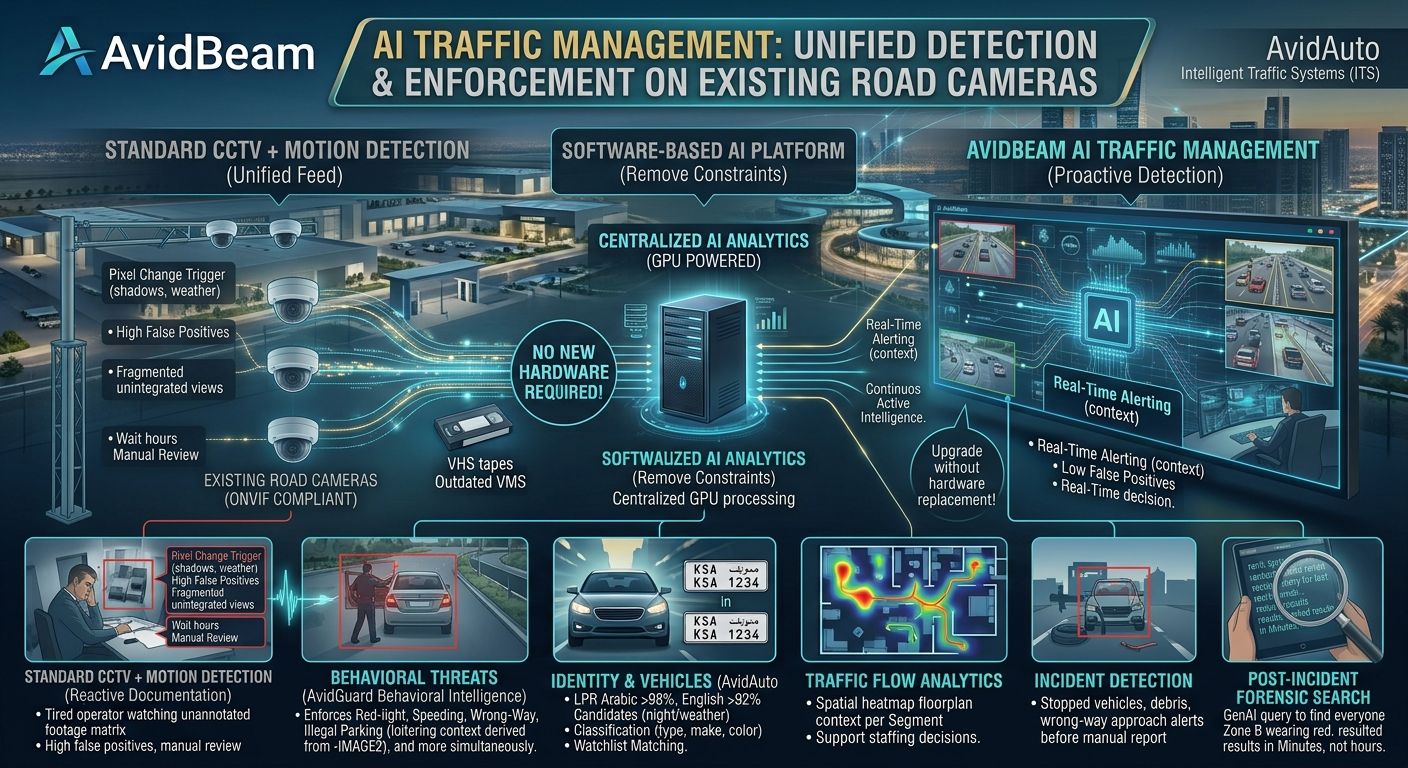
| What is AI traffic management?AI traffic management is a platform that applies artificial intelligence to road camera feeds to detect violations, monitor traffic density, identify incidents, and produce flow analytics continuously without officers stationed at individual camera points. It enforces violations such as red-light running, speeding, wrong-way driving, and illegal parking automatically, generates structured enforcement records per event, and feeds congestion forecasting and signal timing decisions from the same camera infrastructure. |
Traffic management that depends on officer presence has a structural ceiling. An officer at one intersection enforces violations at that intersection during that shift. Every other segment, every off-peak hour, and every violation type the officer is not specifically watching goes unenforced.
AI traffic management removes that ceiling. It applies video analysis to every camera-covered road segment simultaneously, enforcing every configured violation type continuously across all hours without shift gaps. Furthermore, it converts the same camera feeds into traffic flow data: volume per segment, density monitoring, congestion alerts, and historical pattern analysis for infrastructure planning.
AvidBeam's AvidAuto platform delivers AI traffic management through its AB - Intelligent Traffic Systems (ITS) module. AB - ITS connects to existing cameras through a server-based Artificial Intelligence (AI) architecture, produces enforcement documentation per violation event, and feeds volume and density analytics from the same processing pipeline. No dedicated traffic enforcement hardware is required at individual road points.
What Does AI Traffic Management Actually Detect?
The detection range of an AI traffic management system determines what it can enforce and what data it can produce. A system covering only one or two violation types addresses a fraction of the enforcement challenge. AvidBeam's AB - ITS covers nine detection categories from the same camera feeds simultaneously.
Violation Enforcement
As covered in AvidBeam's analysis of traffic detection and what manual monitoring misses, the violation types that matter most in any road environment are not limited to one category. Red-light violations occur at intersections. Wrong-way entries occur at access ramps and one-way roads. Speeding occurs on internal access roads and expressway segments. Illegal parking occurs in loading bays, emergency zones, and restricted areas. A traffic management system that only covers one of these produces partial enforcement that drivers quickly learn to navigate around.
AB - ITS enforces all seven major violation types simultaneously from each connected camera:
- Red-light running at monitored intersections
- Wrong-way driving at access points and one-way segments
- Speeding measured against segment-specific speed limits
- Illegal parking in prohibited zones beyond the configured time threshold
- Sudden lane switching and restricted-lane entry violations
- Mobile phone use while driving at monitored points
- Seatbelt non-compliance per occupant at monitored camera positions
Traffic Flow and Density Monitoring
Beyond violation enforcement, AB - ITS generates traffic intelligence from the same camera feeds. Vehicle volume per lane and direction updates by time window. Density measurement per segment fires congestion alerts when concentration exceeds the configured threshold. Peak period identification by hour and day feeds signal timing decisions and infrastructure planning workflows.
Incident detection runs alongside volume monitoring. Stopped vehicles in active lanes, debris on road surfaces, and wrong-way movement at approach points generate alerts at the moment of detection, before the traffic authority receives a manual report from a driver or patrol unit.
| Want to know which cameras in your road network qualify for AvidBeam's AI traffic management platform? Send an email to info@avidbeam.com for an infrastructure assessment. |
How Does AI Traffic Management Work Without New Hardware?
AI traffic management that requires dedicated enforcement cameras at every coverage point imposes a cost that scales directly with network size. Every new intersection or road segment needs new hardware installed, commissioned, and maintained.
AvidBeam's server-based architecture removes that constraint. AB - ITS connects to any Open Network Video Interface Forum (ONVIF) compliant camera already installed via standard network protocols. All processing happens centrally on dedicated server infrastructure. Consequently, every camera already covering a road segment becomes a traffic enforcement and analytics point through a software deployment rather than a hardware installation project.
The minimum camera requirements are straightforward: 2 Megapixel resolution minimum up to 4K, lens focal length between 3mm and 25mm, and ONVIF compliance for standard network connection. The server infrastructure baseline is 2GB RAM and one virtual core at 2.4 GHz per connected camera.
What Does an AI Traffic Management System Produce Per Violation Event?
As covered in AvidBeam's analysis of how AB-ITS turns every camera into an enforcement point, the enforcement record quality determines whether citations are legally defensible and whether the data is useful for planning purposes. A basic system logs a timestamp and camera source. AvidBeam's AB - ITS generates a complete enforcement record per event.
Each violation event produces:
- License plate number read by Arabic and English Optical Character Recognition (OCR) at 98%+ and 92%+ accuracy respectively
- Vehicle type, make, model, and color classification
- Violation type and specific rule breached
- Camera source and road segment identifier
- Timestamp of detection
- Event clip showing the violation
The record is complete at the moment of detection. No officer needs to manually document the incident or review footage afterward. The structured record is immediately available for citation processing, compliance reporting, and legal documentation.
Full AI Traffic Management Capability Breakdown
The table below maps every capability AvidBeam's AI traffic management platform delivers, how each one works, and what it produces operationally.
| AI Traffic Capability | How It Works | What It Produces |
|---|---|---|
| Vehicle detection and classification | AI identifies every vehicle in frame with type, make, model, and color | Full vehicle profile per event; not just a count or presence log |
| License plate recognition | Arabic and English plates read simultaneously at 98%+ and 92%+ | Plate identity linked to every traffic event automatically |
| Red-light violation | Vehicle detected crossing against a red signal | Alert and enforcement record generated at the moment of violation |
| Wrong-way detection | Vehicle moving against the permitted direction | Immediate alert before the vehicle reaches oncoming traffic |
| Speeding detection | Vehicle speed measured against segment-specific limits | Enforcement record with plate, speed, timestamp, and clip per event |
| Illegal parking | Vehicle stopped in a prohibited zone beyond configured threshold | Alert fires while the vehicle is still present; enforcement is proactive |
| Lane switching violation | Improper lane change or restricted-lane entry | Logged per event with full vehicle profile and clip automatically |
| Mobile phone use | Phone use identified at monitored intersections | Alert and clip per event; supports enforcement and awareness programs |
| Seatbelt non-compliance | Seatbelt absence detected per occupant | Logged per event with plate and vehicle profile per detection |
| Traffic density monitoring | Vehicle volume and distribution per segment by hour | Congestion forecasting and signal timing decisions from existing camera feeds |
| Incident detection | Stopped vehicles, debris, wrong-way movement in active lanes | Alert fires at detection; before traffic authority receives a manual report |
| Parking occupancy | Real-time structure occupancy via AB - Smart Parking | Double-parking, zone violations, and overtime alerts across monitored levels |
Officer-Dependent vs. AI Traffic Management
The table below sets out where AI traffic management diverges from officer-dependent enforcement across the coverage, consistency, documentation, and planning dimensions.
| Dimension | Officer-Dependent Traffic Management | AI Traffic Management |
|---|---|---|
| Coverage | Intersections and segments where officers are present | Every camera-covered segment simultaneously, across all hours |
| Enforcement consistency | Varies by shift, staffing, and officer attention | Identical enforcement standards across all monitored points at all times |
| Violation documentation | Manual citation; no standardized clip or vehicle profile | Automated record: plate, vehicle profile, violation type, timestamp, and clip |
| Traffic data | Not produced from officer observation | Volume, density, and flow data per segment feeds planning and signal decisions |
| Congestion response | Reported after congestion has already formed | Alert fires as density builds; response before bottleneck affects adjacent segments |
| Incident detection | Reported by drivers or observed by patrol | Stopped vehicles and lane obstructions detected automatically at camera points |
| Scalability | Additional officers required per new enforcement point | Software extension to cameras already covering new segments |
| Hardware requirement | Fixed enforcement cameras or officer equipment per point | Layers onto existing ONVIF compliant cameras; no new hardware per point |
Officer-dependent traffic management enforces where officers are stationed. AI traffic management enforces everywhere cameras are installed, continuously, with consistent documentation standards at every detection point.
Where Is AI Traffic Management Applied?
- Urban road networks: intersection enforcement, density monitoring, signal timing optimization, and congestion alerts across city-scale camera deployments from one centralized management interface
- Highway and expressway segments: speeding detection, wrong-way entry monitoring, incident detection, and flow analytics across extended segments without dedicated sensor infrastructure at each point
- Facility and campus access roads: internal speed and violation enforcement, delivery vehicle tracking, access road congestion monitoring, and integration with gate vehicle intelligence
- Smart city infrastructure: city-scale traffic intelligence feeding urban planning, infrastructure investment, and signal optimization from verified camera data as demonstrated in AvidBeam's 18,000-camera deployment in Riyadh
- Parking structures: AB - Smart Parking extends AI traffic management into structures with real-time occupancy monitoring, double-parking detection, and permit compliance without dedicated bay sensors
FAQ
What is AI traffic management?
A platform that applies AI to road camera feeds to enforce violations, monitor traffic density, detect incidents, and generate flow analytics continuously without officers at individual camera points.
What violation types does AI traffic management enforce?
Red-light running, wrong-way driving, speeding, illegal parking, lane switching violations, mobile phone use while driving, and seatbelt non-compliance, all from the same camera feeds simultaneously.
Does AI traffic management require new cameras?
No. AvidBeam's AB - ITS connects to any existing ONVIF compliant camera with 2MP minimum resolution; all processing runs on a central server, not at individual camera points.
What does an AI traffic management system produce per violation?
License plate number, vehicle type, make, model, color, violation type, camera source, segment identifier, timestamp, and event clip, all generated automatically at the moment of detection.
Can the system monitor congestion and enforce violations on the same cameras?
Yes. Volume monitoring, density alerting, incident detection, and violation enforcement all run through the same AB - ITS platform on the same connected camera feeds.
How does AI traffic management scale to new road segments?
Coverage extends through software configuration to cameras already covering new segments; no new enforcement hardware installation is required per additional coverage point.
What accuracy does license plate recognition achieve for traffic enforcement?
AvidBeam's AB - ITS sustains 98%+ accuracy for Arabic plates and 92%+ for English, sustained under low light, adverse weather, and high vehicle speeds through server-based centralized processing.
| Want to see AI traffic management in action?Request a live demo of AvidBeam's AvidAuto platform on your existing road cameras. Send an email to info@avidbeam.com to schedule a session with the technical team. |
 Article
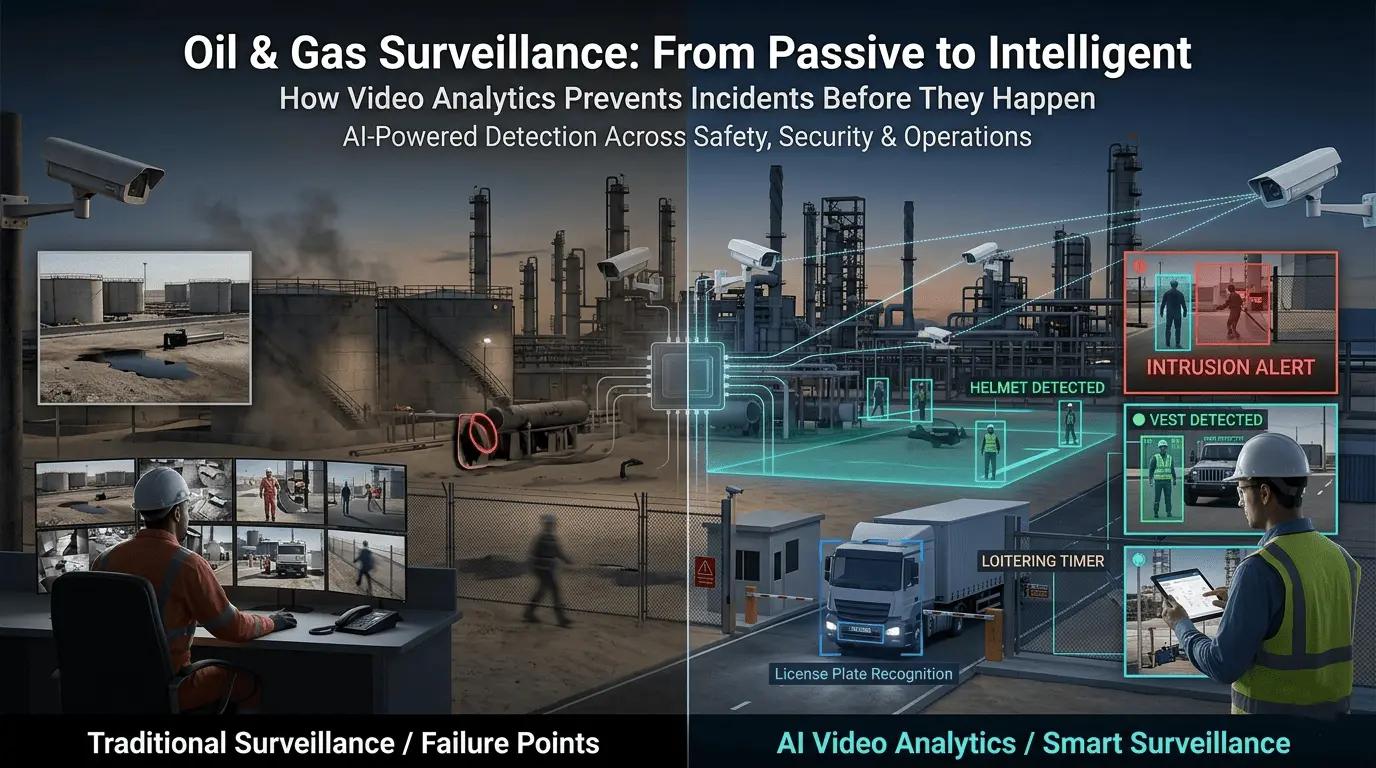
Oil and Gas Video Surveillance: How AI Covers PPE Compliance, Fire Detection and Perimeter Security Simultaneously
Oil and gas video surveillance should go beyond recording. In a petrochemical or refinery environment, cameras should automatically verify Personal Protective Equipment (PPE) compliance per worker per zone
 Article
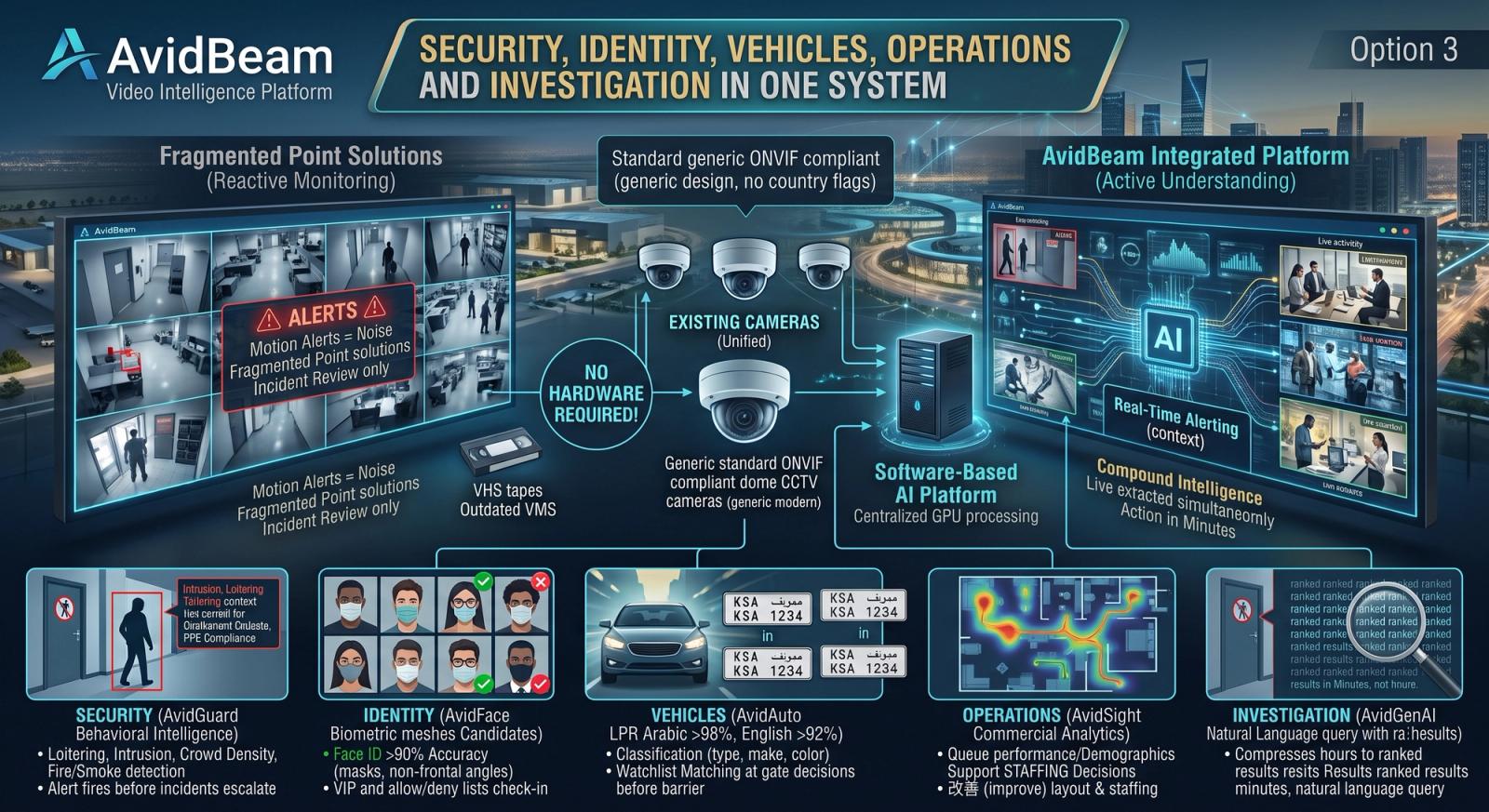
Video Intelligence Platform Explained: Security, Identity, Vehicles, Operations and Investigation in One System
A video intelligence platform is a software system that extracts multiple categories of structured intelligence from camera feeds simultaneously: behavioral security alerts, identity verification
 Article
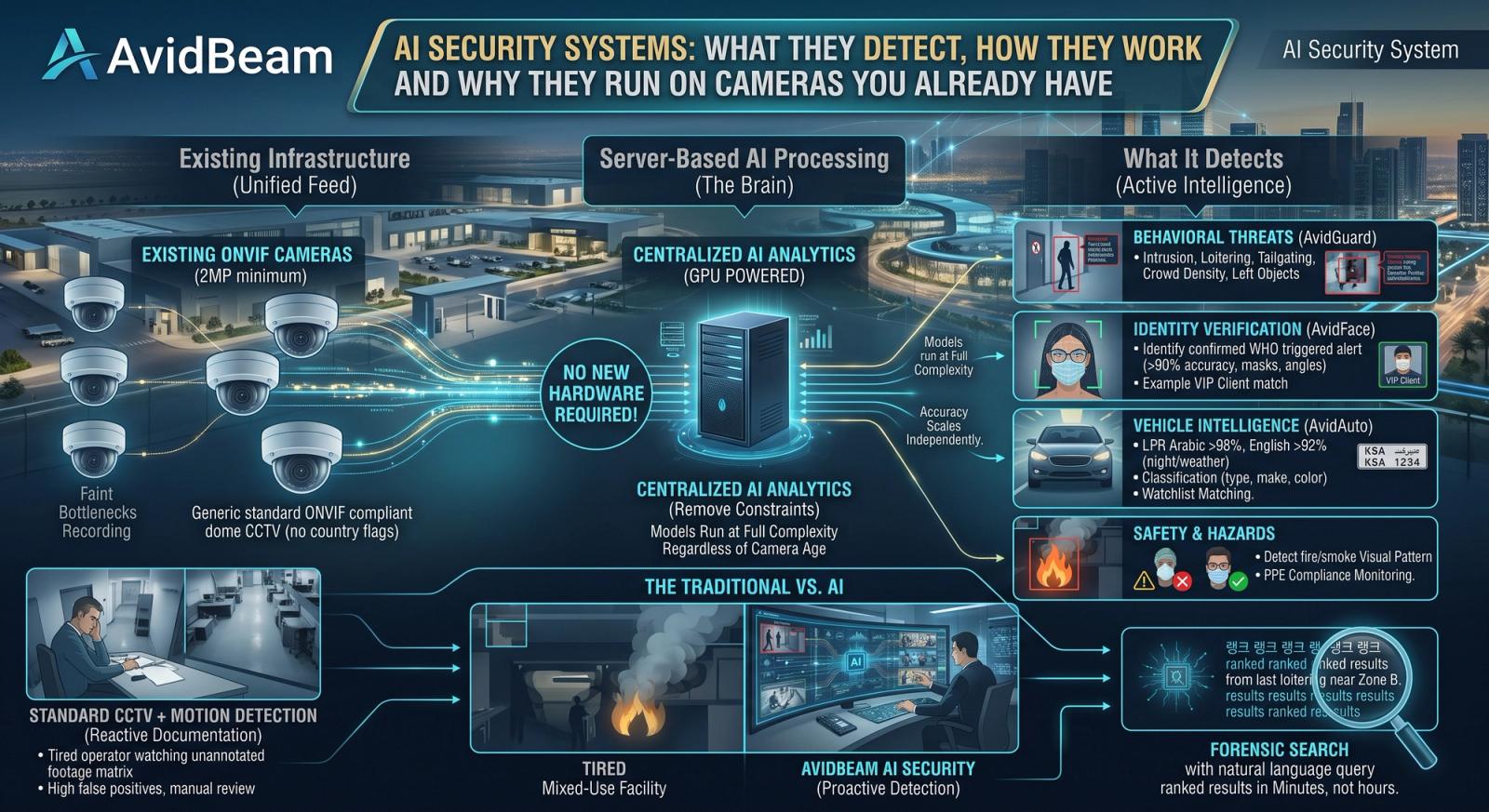
AI Security Systems: What They Detect, How They Work and Why They Run on Cameras You Already Have
An AI security system is a platform that applies artificial intelligence to camera feeds to detect threats, verify identities, and generate security alerts automatically, without requiring a person to monitor screens continuously.
Experience AI Video Analytics
on your existing cameras.
Start with a pilot deployment and scale seamlessly as your operational requirements evolve.